





You want a short list you can trust. You also want context, because every B2B team runs a different playbook. This guide gives you both. You’ll see where each email marketing platform shines for b2b email marketing, how it fits into a practical email marketing software stack, and how to choose the right email marketing platform in 2026 without wasting a week on demos.
This page uses the terms you care about in a natural way. b2b, best email marketing, b2b emails, email marketing tool, email marketing service, free email marketing, best email marketing services. No filler. Just what helps you plan email marketing campaigns that convert.
How B2B Email Marketing Is Different
B2B inboxes are crowded. The buyer journey is slower. People forward your marketing emails to a manager. Finance weighs in. Security checks your product. Your email marketing strategy should reflect that. That matters because it keeps your team focused on the next send, not the next tool.
Use marketing automation for multi-step nurtures, lead scoring, and a clean handoff to sales. Keep marketing and transactional email in one system when you can, so data stays together. Maintain a tidy email list, protect deliverability, and work from simple templates your team can ship fast. If you also run SMS marketing, look for email and SMS under one roof. And watch your number of monthly email sends so pricing does not surprise you as the database grows.
Let’s get to the tools.
14 Best Email Marketing Platforms for B2B Companies
Each pick includes where it fits, standout marketing features, and a quick “pick it if” note. I mention free plan or 14-day free trial only when it changes the decision. I’m writing this the way a working marketer would talk with a teammate.
1) HubSpot Marketing Hub
Best for: All-in-one email marketing and CRM with tight sales and marketing alignment.
Why it works: HubSpot keeps capture, nurture, and reporting in one place. The email editor is friendly and the automation builder handles complex branching without code. I’ve seen SDRs book more meetings because the contact timeline shows every email send, page view, and reply in one record.
Pick it if: You want one email marketing solution that covers forms, landing pages, workflows, and revenue reporting. You plan to scale and don’t want duct tape later.
2) ActiveCampaign
Best for: Teams that live in automation.
Why it works: The journey builder is the reason people choose it. You can react to page visits, webinar signups, deal stage changes, and more. It stays flexible without getting chaotic, which matters when real buyers do not follow perfect funnels.
Pick it if: You want advanced email workflows that adapt to behavior, score leads, and nudge the right contacts toward sales.
3) Mailchimp
Best for: Small businesses and startups that need basic email marketing with room to grow.
Why it works: You can spin up email campaigns quickly. Templates are clean, the email builder is simple, and it is easy to teach a teammate. I’ve used it for early launches where speed mattered more than fancy logic.
Pick it if: You need no-frills email marketing to get your b2b emails out the door this week. A free plan may be available on entry tiers.
4) Brevo (formerly Sendinblue)
Best for: Email and SMS together with fair pricing.
Why it works: Brevo makes it straightforward to run marketing and transactional emails in one account. That helps when your team sends promos and password resets from the same brand domain. Deliverability is solid for the price.
Pick it if: You want one email service that handles promotions, alerts, and time-sensitive sends without juggling vendors.
5) MailerLite
Best for: Clean UI, quick landing pages, and good email templates.
Why it works: It is calm software. You get what you need, and almost nothing you don’t. I’ve had content teams adopt it in a day, then ship a newsletter and a lead magnet page by Friday.
Pick it if: You want a light email tool to ship quality campaigns without extra complexity. Many plans include a free plan to start.
6) GetResponse
Best for: Webinars plus email in one stack.
Why it works: If demos and workshops drive your pipeline, having webinars, funnels, and marketing automation together saves time. Fewer integrations. Fewer points where tracking breaks.
Pick it if: You host product tours or training sessions often and want follow-ups to run themselves.
7) Campaign Monitor
Best for: Design-first B2B brands that care about polish.
Why it works: The email design tools are excellent. You get tidy email templates to choose from and a builder that respects brand guidelines. I’ve seen teams standardize beautiful sends across regions without a weekly design fire drill.
Pick it if: You want consistently responsive email with minimal setup time and tight visual control.
8) Klaviyo
Best for: B2B ecommerce and product-led growth.
Why it works: Klaviyo shines when events and usage matter. You can target by product activity, plan tier, or in-app actions. It is great for expansion and upsell flows that feel timely instead of spammy.
Pick it if: You need behavior-based email marketing automation tied to product data or purchases.
9) SendGrid Marketing Campaigns
Best for: Engineering-friendly email delivery at scale.
Why it works: SendGrid’s superpower is deliverability and email authentication. If your team sends a mix of marketing and high-volume transactional messages, proven infrastructure helps. The campaigns UI lets marketers build without leaning on devs for every send.
Pick it if: Inbox placement is your top concern and you want API strength with a visual layer for marketers.
10) Moosend
Best for: Budget-conscious teams that still want automation.
Why it works: Moosend covers the core jobs well. Segmentation, visual flows, and a clean email editor. I like it for lean teams that need structure and do not want to overpay while they grow.
Pick it if: You want one of the best free or low-cost paths into proper nurturing and can live without niche extras.
11) Constant Contact
Best for: B2B nonprofits, associations, and event-heavy calendars.
Why it works: Event invites, reminders, and follow-ups are where it is comfortable. Reporting is clear. The learning curve is gentle for coordinators who wear many hats.
Pick it if: You run lots of webinars or community updates and want your stack to stay simple.
12) Drip
Best for: Product-led B2B with lifecycle focus.
Why it works: Drip keeps journeys readable while still letting you build thoughtful lifecycle flows. Tags and events make it easy to nudge trial users toward activation, then toward expansion.
Pick it if: You want lifecycle messaging that maps to how your product gets adopted.
13) ConvertKit
Best for: B2B creators, consultants, and boutique agencies.
Why it works: It helps you sound human at scale. The email builder is straightforward, sequences are easy, and tagging keeps audiences organized. I’ve watched solo consultants grow real pipelines with a weekly note and two smart automations.
Pick it if: Thought leadership drives your sales motion and you want personal tone with simple segmentation.
14) Mailjet
Best for: Collaboration and multilingual teams.
Why it works: Real-time co-editing, roles, and approvals make governance easier. That matters when multiple people build emails and brand consistency is non-negotiable. Deliverability holds up well, too.
Pick it if: You work across regions or departments and need shared templates without chaos.
Email Marketing Tools Compared: Which Fits Your 2026 Plan
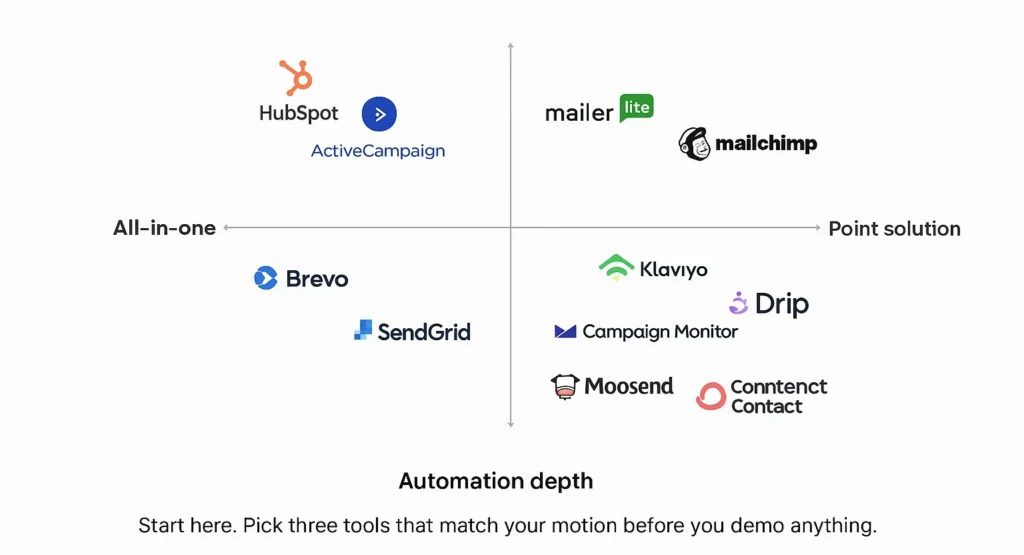
Want all-in-one email marketing with CRM? HubSpot.
Want the most flexible automations? ActiveCampaign.
Want free email marketing to start small? MailerLite or Mailchimp.
Need reliable transactional email plus marketing? Brevo or SendGrid.
Running frequent webinars? GetResponse.
Care most about polished visuals? Campaign Monitor.
Product-led and behavior heavy? Klaviyo or Drip.
Creator-led B2B? ConvertKit.
Distributed team collaboration? Mailjet.
Tight budget with automation needs? Moosend.
Event-driven sends for associations? Constant Contact.
Here is why that matters. Shortlists cut noise and save budget. Once you have three options that match your motion, you can compare what counts and stop chasing shiny features.
B2B vs B2C Email Marketing
You will use some of the same tools, yet the priorities change. B2B leans on education and proof. Case studies, pricing explainers, and comparison guides. You are convincing a group, not a solo shopper. B2C leans on emotion and urgency. Journeys are shorter and offer-driven. That is fine, only different.
For B2B, add these steps to your b2b email marketing strategy:
- Map stages. Problem aware, solution aware, vendor aware, buy or renew
- Build one evergreen email automation per stage
- Alert sales when someone hits intent signals that matter to you
- Give every email one clear next step. Fewer choices, more action
I have seen this play out often. When teams stop over-emailing and start guiding, reply rates and pipeline move.
Must-Have Features in a B2B Email Mar keting Tool

Use this checklist when you evaluate the best b2b email marketing software. Keep it practical.
Deliverability and authentication
Set SPF, DKIM, and DMARC. Protect the brand. Without inboxing, nothing else matters.
Intuitive drag-and-drop email builder
Shave hours off production. Keep email design on brand. Let more than one person ship a send.
Automation tools
Use visual workflows, goals, and simple testing. Cover onboarding, post-webinar, expansion, and renewals. Build the ones you will actually maintain.
Email marketing and CRM integration
Sales needs context. Choose a right email marketing platform that syncs deals and engagement both ways so reps are not guessing.
Transactional email option
Send order notes, password resets, and usage alerts. If you combine email types in one place, support is easier and tone stays consistent.
Segmentation and personalization
Filter by firmographic fields, plan tiers, last activity, and original source. Relevance beats volume every time.
Templates and blocks
Reuse blocks to keep marketing campaigns consistent and faster to produce.
Reporting beyond opens
Track pipeline influenced, meetings booked, trials started, and activation. That is how you defend budget.
Compliance and roles
Permissions and approvals protect larger teams from last-minute mistakes.
Pricing clarity
Check contacts, email sends per month, add-ons, and whether there is a free plan or 14-day free trial to test with real content.
Free Plan or Paid. How to Decide
A free email marketing tier helps when you test tone, build early sequences, or validate ICP. It is a smart way to learn what your audience will actually open.
Move to paid when you need multi-branch automation tools, more seats for sales or marketing, higher email delivery limits or dedicated IPs, and deeper integrations with custom fields. One more thought. Free often works for the first thousand contacts. Paid makes sense once email becomes your marketing hub and you need reliability week after week.
The Right Email Marketing Platform for Your Audience
There is not a universal winner. There is a best email marketing tool for your stage, motion, and limits. Ask yourself:
- What is the one send that will move pipeline this quarter
- Do we need advanced marketing automation, or will one simple sequence deliver most of the value
- Where is the source of truth for leads and accounts
- Who builds the email templates, and who presses send
- Do we need email and SMS, or email only
Be honest with these. Your shortlist gets obvious fast.
Final Checklist Before You Buy
Walk into your 2026 review with this and you will pick well.
- A clear use case you can measure in 30 days
- A shortlist of three best email marketing services that fit your budget
- Proof the platform handles marketing and transactional emails
- A working sample email campaign in their email editor
- One test email automation built during the trial
- A pricing check on contacts and email sends per month
- Alignment with sales on fields, lifecycle stages, and alerts
I have seen teams skip these steps and regret it. A one-page scorecard beats a month of meetings.
Let’s Build Campaigns That Convert
If you want b2b emails that do more than look good, the team at Success Instigators can help. We plan email marketing campaigns, write copy that lands, and build sequences that match how your buyers make decisions. You get a simple strategy, clean email templates, and a process your team can run.
Ready to build a program that ships every week and moves deals forward. Start here with Success Instigators.